
FinWise budgeting guide
How to Budget on an Irregular Income
Last updated: November 14, 2026
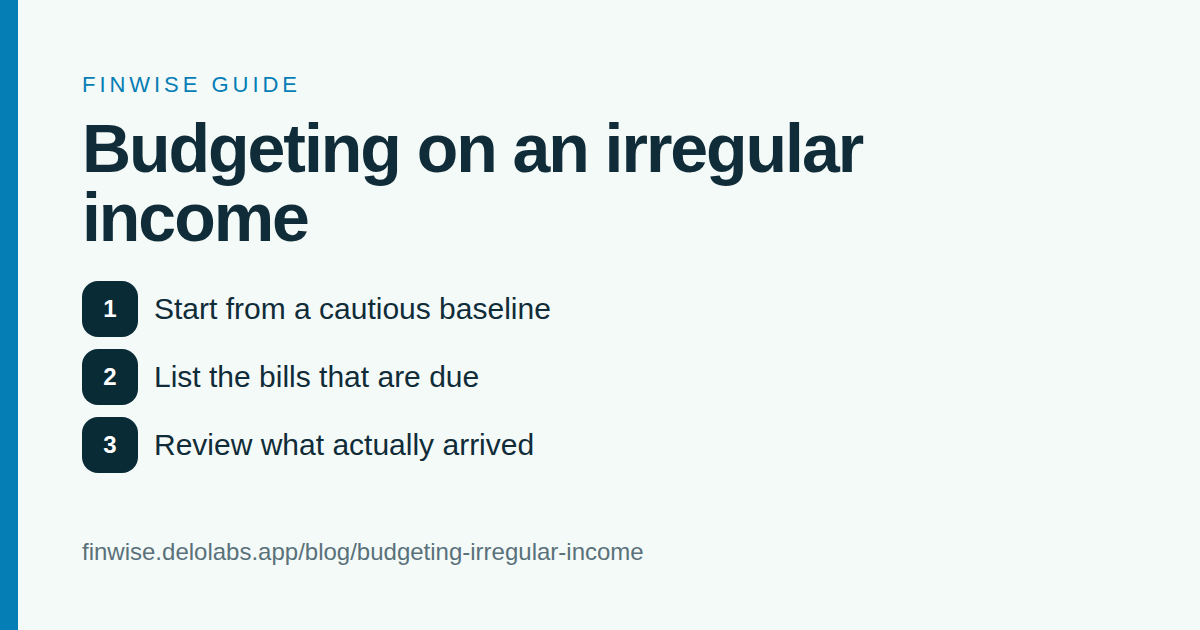
A variable paycheque can make a fixed monthly plan feel out of step. This guide offers a simple way to map income and expenses, plan for bills that arrive unevenly, and revise the plan as you learn more about your actual spending. It is general education, not personal financial, tax, or legal advice.
1. Start with your actual take-home pay
Gather recent payslips, invoices, or your own records and note what reached you after deductions. Include different pay sources you rely on, but keep tax and benefit questions tied to current guidance in your country. Looking across several pay periods helps show a lower, typical, and higher month without treating one unusually good month as normal.
If income varies from month to month, MoneyHelper’s UK guide suggests building a plan around the lowest monthly income. Treat that as a cautious starting point, not a forecast or a rule that works for every household.
2. Map bills before flexible spending
Write down essential commitments, the amount due, and the date each payment is expected. Add costs that arrive quarterly or once a year—such as insurance, school costs, or vehicle maintenance—so they do not disappear simply because they are absent from this month’s statement. If it is affordable, dividing a known yearly bill into monthly set-asides can make the timing easier to see.
Do not share bank passwords, card numbers, or account credentials with a budgeting tool. Use statements or receipts you are comfortable reviewing, and keep your records private.
3. Make a flexible plan for the money left
After listing bills and planned set-asides, decide how to handle what remains for food, travel, household needs, and optional spending. Some people find it useful to check the available amount weekly or between paydays. Leave room for necessary costs that are hard to predict; avoid copying a percentage split from someone else as if it were universal. If you want to compare 50/30/20, zero-based, envelope, pay-yourself-first, and 80/20 plans, read five budgeting methods and how to track them.
4. Give higher-income months a job
When more money arrives than your cautious baseline, look ahead at known bills and expenses before increasing flexible spending. If you can, consider a buffer for months when income is lower. The right order depends on your obligations and circumstances; this guide does not replace local debt, benefits, tax, or financial advice.
5. Review actual spending and adjust
Compare the plan with what you actually received and spent after each pay cycle. Note which categories repeatedly differ, then adjust those categories rather than rebuilding the whole plan every day. Keep cash purchases and one-off costs in the picture if they matter to your household.
A simple worksheet
Copy these headings into a notebook or spreadsheet. Fill in only what is useful to you.
| Period | Take-home income | Bills due | Everyday spending | Irregular costs | Review note |
|---|---|---|---|---|---|
| Pay period 1 | Record actual | List dates and amounts | Record actual | Record or set aside if possible | What changed? |
| Pay period 2 | Record actual | List dates and amounts | Record actual | Record or set aside if possible | What changed? |
| Next review | Update baseline | Check upcoming dates | Adjust only where needed | Check known future costs | Choose a review date |
Free resources by country
- United States: the CFPB’s budgeting guide and Your Money, Your Goals tools.
- United Kingdom: MoneyHelper’s irregular-income guide.
- Canada: the Financial Consumer Agency of Canada’s budgeting guidance and planner.
- Australia: ASIC Moneysmart’s guide to managing a casual income and budget steps.
For local tax, benefit, debt, or hardship support, use the relevant official service in your country. A spending tracker can help keep a record; it cannot decide what is right for you.
How FinWise can help with record keeping
FinWise is an Android expense tracker. You can capture a receipt, voice note, payment detail, or manual entry as a draft, review the details, and then save it. Its spending categories, budgets, recurring-spend view, and savings goals help organize records; FinWise does not send payments or provide personalized financial advice. If you do not want to connect a bank account, see how FinWise tracks expenses without linking a bank.
Sources and review notes
Sources checked October 24, 2026. This guide summarizes public educational resources in original wording. Product descriptions were checked against the live FinWise website and official Google Play listing. It has no named financial-professional reviewer and is not a substitute for one-to-one advice.